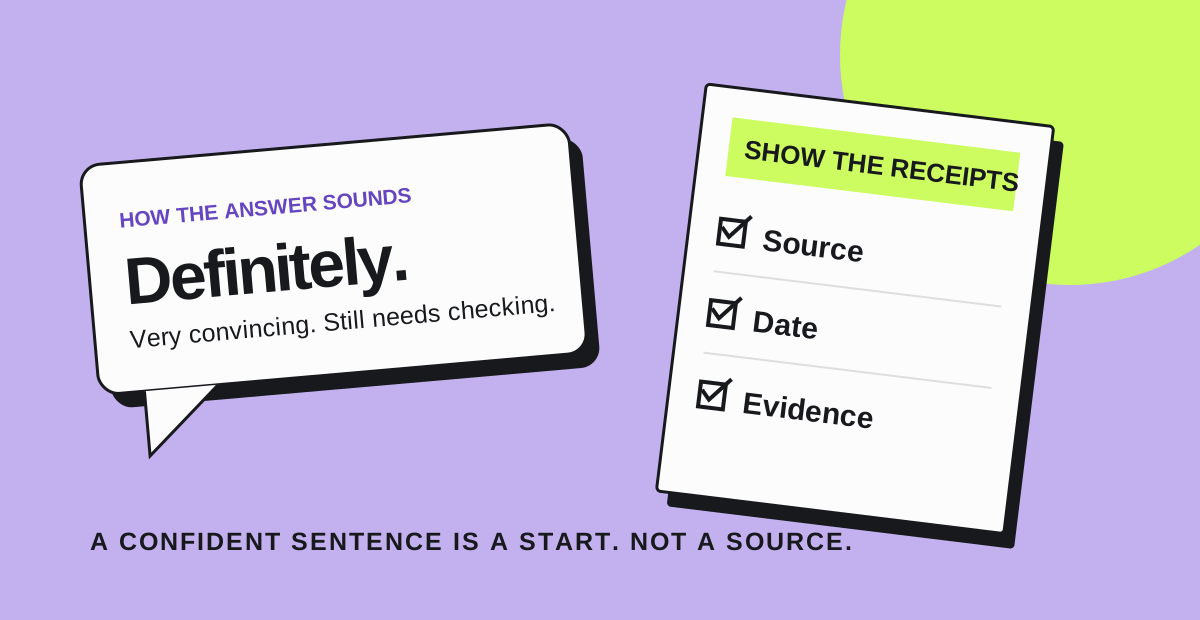
The AI sounds certain. That’s not the same as right.
A confident sentence is a writing style. Evidence is a separate job.
SIDEQUEST · 3 MIN READ · 19 NOVEMBER 2026 · AI-assisted editorial work
THE QUICK TAKE
AI can give incorrect or misleading answers. A polished tone does not tell you whether a claim is supported. Open the source, check the date and look for actual evidence.
A confident answer feels reassuring. So does someone confidently giving you directions to entirely the wrong station.
The useful question is not “does this sound clever?” It is “what supports it?” That question works on chatbots, headlines, viral posts and this website. Especially this website.
Start with one claim.
Pick the exact sentence you want to check. “This is the best app” is a judgement. “This app costs £5 each month” is a factual claim you can investigate. Those need different kinds of evidence.
A link is a starting point, too. Open it. Does the original page actually say the thing the answer claims? Does it support the number, or merely mention a similar topic? A citation that wears the right outfit can still be at the wrong party.
The date gets a vote.
A price from last year might have changed. A planned launch is not proof that something launched. “Researchers hope” is not the same as “researchers found”. Read the words around the claim, not only the exciting bit.
For arithmetic, redo the calculation. For a quote, find the original wording and context. For a company promise, label it as the company's promise rather than an independent result.
Two links can still be one source.
Look for another source with its own evidence. If several articles all repeat the same announcement, you have found several copies of an announcement. That can be useful context, but it does not magically become independent confirmation.
If reliable sources disagree, keep the disagreement visible. If you cannot find support, “I don't know yet” is a perfectly useful answer. It leaves room for evidence to turn up.
Your brain stays on the team.
AI can help you explore a topic or work out what to ask next. You still get to inspect its work. For a serious personal concern, involve a trusted person instead of relying on a chatbot's confident voice.
YOUR MOVE
Before repeating a claim, ask: what is the original source, what does it actually support, and when was it checked?
SHOW THE RECEIPTS
The guidance behind this.
UK Safer Internet Centre: 2026 tips for young people explains that AI can be incorrect or misleading and encourages checking other sources and talking with trusted people. Our three-check diagram and examples are Sidequest's editorial explanation.
Source checked 19 November 2026. The price example is hypothetical. AI-assisted editorial work; this is a checking habit, not a guarantee that any source or tool is always right.
Source links open outside Sidequest. Something needs correcting?